
By Spaceweather.com, 09/03/2015
FLATLINING: Solar activity is very low. With no flare-producing sunspots on the solar disk, the sun’s X-ray output is flatlining. NOAA forecasters say the odds of a strong solar flare on Sept. 3rd is no more than 1%. Solar flare alerts: text or voice
RED AIRGLOW OVER CHILE: On Sept. 1st, astrophotographer Yuri Beletsky hiked into the Atacama Desert of Chile for a deep exposure of the Milky Way. He got that and much more. “There was a stunning display of red airglow,” he says. It surrounded the Milky Way like a celestial bulls-eye:

Airglow is aurora-like phenomenon caused by chemical reactions in the upper atmosphere. Human eyes seldom notice the faint glow, but It can be photographed on almost any clear dark night, anywhere in the world.
The curious thing about Beletsky’s photo is not the presence of airglow, but ratherits color–red. Airglow is usually green, the color of light from abundant oxygen atoms in a layer 90-100 km high. Where does the red come from? Instead of oxygen, less abundant hydroxyl ions (OH-) can produce the required color. These ions exist in a thin layer 85 km high where gravity waves impress the red glow with a dramatic rippling structure.
“It was a truly special night,” says Beletsky. “Pure tranquility.”
Realtime Space Weather Photo Gallery
RED SPRITES OVER EUROPE: As September begins, solar activity is low. Nevertheless, space weather continues. High above thunderstorms in Europe, red sprites are dancing across the cloudtops, reaching up to the edge of space itself. Martin Popek photographed these specimens on Sept. 1st from Nýdek, the Czech republic:

“I used a zoom lens for a close-up view of these sprites, which could just be seen over the treetops as they jumped upward from a distant storm,” says Popek.
Inhabiting the upper reaches of Earth’s atmosphere alongside noctilucent clouds, meteors, and some auroras, sprites are a true space weather phenomenon. Some researchers believe they are linked to cosmic rays: subatomic particles from deep space striking the top of Earth’s atmosphere produce secondary electrons that, in turn, could provide the spark that triggers sprites.
Although sprites have been seen for at least a century, most scientists did not believe they existed until after 1989 when sprites were photographed by cameras onboard the space shuttle. Now “sprite chasers” regularly photograph the upward bolts from their own homes. Give it a try.
156 YEARS AGO, A GEOMAGNETIC MEGA-STORM: On Sept. 2nd, a billion-ton coronal mass ejection (CME) slammed into Earth’s magnetic field. Campers in the Rocky Mountains woke up in the middle of the night, thinking that the glow they saw was sunrise. No, it was the Northern Lights. People in Cuba read their morning paper by the red illumination of aurora borealis. Earth was peppered by particles so energetic, they altered the chemistry of polar ice.
Hard to believe? It really happened–156 years ago. This map shows where auroras were sighted in the early hours of Sept. 2, 1859:

As the day unfolded, the gathering storm electrified telegraph lines, shocking technicians and setting their telegraph papers on fire. The “Victorian Internet” was knocked offline. Magnetometers around the world recorded strong disturbances in the planetary magnetic field for more than a week.
The cause of all this was an extraordinary solar flare witnessed the day before by British astronomer Richard Carrington. His sighting marked the discovery of solar flares and foreshadowed a new field of study: space weather. According to the National Academy of Sciences, if a similar storm occurred today, it would cause a trillion dollars in damage to society’s high-tech infrastructure and require four to ten years for complete recovery.
In fact, a similar flare did occur just a few years ago. On July 23, 2012, a CME of rare power rocketed away from the sun. The storm was in all respects at least as strong as the 1859 Carrington event. The only difference is, it missed. No harm done. The July 2012 event serves as a reminder, however, that extreme space weather is not a thing of the past.
Every night, a network of NASA all-sky cameras scans the skies above the United States for meteoritic fireballs. Automated software maintained by NASA’s Meteoroid Environment Office calculates their orbits, velocity, penetration depth in Earth’s atmosphere and many other characteristics. Daily results are presented here on Spaceweather.com.
On Sep. 3, 2015, the network reported 9 fireballs.
(9 sporadics)

In this diagram of the inner solar system, all of the fireball orbits intersect at a single point–Earth. The orbits are color-coded by velocity, from slow (red) to fast (blue). [Larger image] [movies]
Near Earth Asteroids
Potentially Hazardous Asteroids (PHAs) are space rocks larger than approximately 100m that can come closer to Earth than 0.05 AU. None of the known PHAs is on a collision course with our planet, although astronomers are finding new ones all the time.
On September 3, 2015 there were 1607 potentially hazardous asteroids.
Recent & Upcoming Earth-asteroid encounters:
Asteroid
Date(UT)
Miss Distance
Size
2015 QT3
Aug 28
4.2 LD
71 m
2015 PT227
Aug 29
9.7 LD
69 m
2004 BO41
Aug 31
57.3 LD
1.2 km
1991 CS
Sep 4
62.1 LD
1.4 km
2014 KS76
Sep 14
8.7 LD
22 m
2004 TR12
Sep 15
58.8 LD
1.0 km
2000 FL10
Oct 10
65.7 LD
1.9 km
2011 QD48
Oct 17
67.5 LD
1.0 km
2014 UR
Oct 18
3.8 LD
21 m
2011 SE97
Oct 18
12 LD
50 m
2001 UY4
Oct 21
58.2 LD
1.0 km
2005 UL5
Nov 20
5.9 LD
390 m
Notes: LD means “Lunar Distance.” 1 LD = 384,401 km, the distance between Earth and the Moon. 1 LD also equals 0.00256 AU. MAG is the visual magnitude of the asteroid on the date of closest approach.
Current Conditions
Solar wind
speed: 429.1 km/sec
density: 9.5 protons/cm3
explanation | more data
Updated: Today at 1500 UT
X-ray Solar Flares
6-hr max: C1 1137 UT Sep03
24-hr: C1 1137 UT Sep03
explanation | more data
Updated: Today at: 1400 UT
Daily Sun: 03 Sep 15

With only a few small sunspots dotting the solar disk, solar activity is very low.. Credit: SDO/HMI
Sunspot number: 41
What is the sunspot number?
Updated 03 Sep 2015
Spotless Days
Current Stretch: 0 days
2015 total: 0 days (0%)
2014 total: 1 day (<1%)
2013 total: 0 days (0%)
2012 total: 0 days (0%)
2011 total: 2 days (<1%)
2010 total: 51 days (14%)
2009 total: 260 days (71%)
Updated 03 Sep 2015
The Radio Sun
10.7 cm flux: 88 sfu
explanation | more data
Updated 03 Sep 2015
Current Auroral Oval:

Switch to: Europe, USA, New Zealand, Antarctica
Credit: NOAA/Ovation
Planetary K-index
Now: Kp= 2 quiet
24-hr max: Kp= 3 quiet
explanation | more data
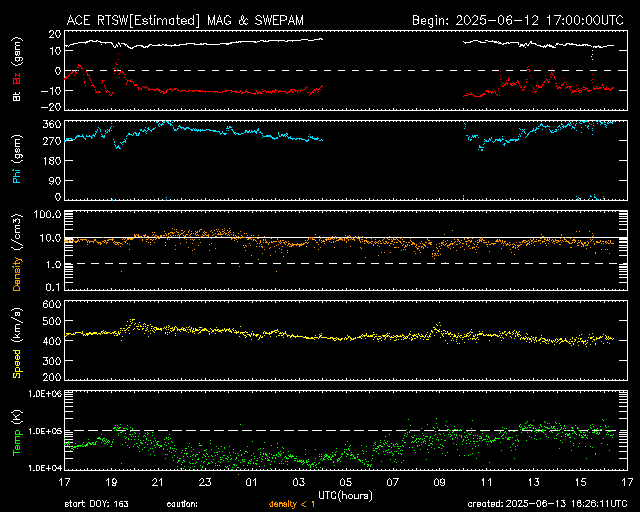
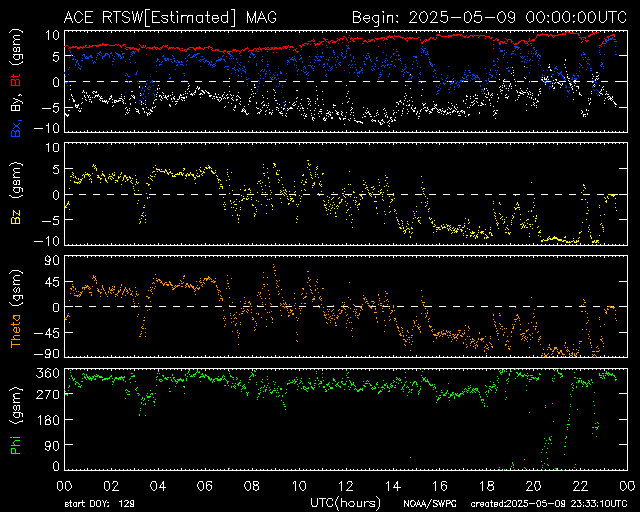
Interplanetary Mag. Field
Btotal: 6.3 nT
Bz: 1.2 nT north
explanation | more data
Updated: Today at 1500 UT
Coronal Holes: 03 Sep 15

Solar wind flowing from the indicated coronal hole could reach Earth on Sept. 6-7. Credit: SDO/AIA.
Noctilucent Clouds
The northern season for NLCs is finished. According to NASA’s AIM spacecraft, the last clouds were observed over Greenland on Aug. 27th. Now the waiting begins for the southern season expected to begin in November.

Switch view: Europe, USA, Asia, Polar
Updated at: 09-01-2015 09:00:00
NOAA Forecasts
Updated at: 2015 Sep 02 2200 UTC
FLARE
0-24 hr
24-48 hr
CLASS M
01 %
01 %
CLASS X
01 %
01 %
Geomagnetic Storms:
Probabilities for significant disturbances in Earth’s magnetic field are given for three activity levels: active, minor storm, severe storm
Updated at: 2015 Sep 02 2200 UTC
Mid-latitudes
0-24 hr
24-48 hr
ACTIVE
30 %
25 %
MINOR
10 %
05 %
SEVERE
01 %
01 %
High latitudes
0-24 hr
24-48 hr
ACTIVE
15 %
15 %
MINOR
25 %
30 %
SEVERE
40 %
30 %
Space Weather Update: 09/03/2015




No comments:
Post a Comment