
By Spaceweather.com, 09/06/2015
FILAMENT ERUPTION, POSSIBLE EARTH-DIRECTED CME: A magnetic filament snaking across the sun’s southern hemisphere erupted during the late hours of Sept. 4th, and it may have hurled a CME toward Earth. Note a clump of dark plasma moving away from the blast site (circled) in this movie recorded by NASA’s Solar Dynamics Observatory (SDO):

The plasma in the SDO movie formed the core of a CME, which SOHO saw racing away from the sun on Sept. 5th. The CME is not heading directly for Earth, but it could deliver a glancing blow to our planet’s magnetosphere on Sept. ~7th. NOAA forecasters are still modeling the event to refine their forecast. Stay tuned for updates. Solar flare alerts: text or voice
Realtime Space Weather Photo Gallery
RED AIRGLOW OVER CHILE: On Sept. 1st, astrophotographer Yuri Beletsky hiked into the Atacama Desert of Chile for a deep exposure of the Milky Way. He got that and much more. “There was a stunning display of red airglow,” he says. It surrounded the Milky Way like a celestial bulls-eye:

Airglow is aurora-like phenomenon caused by chemical reactions in the upper atmosphere. Human eyes seldom notice the faint glow, but It can be photographed on almost any clear dark night, anywhere in the world.
The curious thing about Beletsky’s photo is not the presence of airglow, but ratherits color–red. Airglow is usually green, the color of light from oxygen atoms some 90 km to 100 km above Earth’s surface. Where does the red come from? Instead of oxygen, OH can produce the required color. These neutral molecules (not to be confused with the OH- ion found in aqueous solutions) exist in a thin layer 85 km high where gravity waves impress the red glow with a dramatic rippling structure.
“It was a truly special night,” says Beletsky. “Pure tranquility.”
All Sky Fireball Network
Every night, a network of NASA all-sky cameras scans the skies above the United States for meteoritic fireballs. Automated software maintained by NASA’s Meteoroid Environment Office calculates their orbits, velocity, penetration depth in Earth’s atmosphere and many other characteristics. Daily results are presented here on Spaceweather.com.
On Sep. 6, 2015, the network reported 10 fireballs.
(7 sporadics, 1 alpha Aurigid, 1 September epsilon Perseid, 1 Northern iota Aquariid)

In this diagram of the inner solar system, all of the fireball orbits intersect at a single point–Earth. The orbits are color-coded by velocity, from slow (red) to fast (blue). [Larger image] [movies]
Near Earth Asteroids
Potentially Hazardous Asteroids (PHAs) are space rocks larger than approximately 100m that can come closer to Earth than 0.05 AU. None of the known PHAs is on a collision course with our planet, although astronomers are finding new ones all the time.
On September 6, 2015 there were 1608 potentially hazardous asteroids.
Recent & Upcoming Earth-asteroid encounters:
Asteroid
Date(UT)
Miss Distance
Size
2004 BO41
Aug 31
57.3 LD
1.2 km
1991 CS
Sep 4
62.1 LD
1.4 km
2014 KS76
Sep 14
8.7 LD
22 m
2004 TR12
Sep 15
58.8 LD
1.0 km
2000 FL10
Oct 10
65.7 LD
1.9 km
2011 QD48
Oct 17
67.5 LD
1.0 km
2014 UR
Oct 18
3.8 LD
21 m
2011 SE97
Oct 18
12 LD
50 m
2001 UY4
Oct 21
58.2 LD
1.0 km
2005 UL5
Nov 20
5.9 LD
390 m
Notes: LD means “Lunar Distance.” 1 LD = 384,401 km, the distance between Earth and the Moon. 1 LD also equals 0.00256 AU. MAG is the visual magnitude of the asteroid on the date of closest approach.
Current Conditions
Solar wind
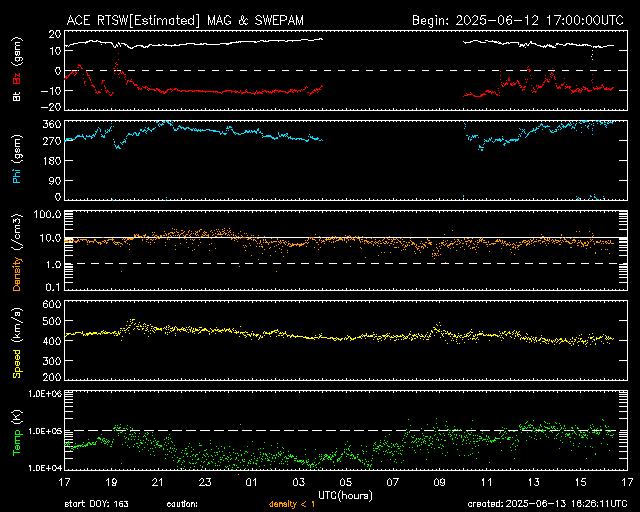
speed: 556.8 km/sec
density: 2.2 protons/cm3
explanation | more data
Updated: Today at 1507 UT
X-ray Solar Flares
6-hr max: B1 0833 UT Sep06
24-hr: B1 0410 UT Sep06
explanation | more data
Updated: Today at: 1500 UT
Daily Sun: 06 Sep 15

Neither of these sunspots poses a threat for strong flares. Solar activity is very low. Credit: SDO/HMI
Sunspot number: 24
What is the sunspot number?
Updated 06 Sep 2015
Spotless Days
Current Stretch: 0 days
2015 total: 0 days (0%)
2014 total: 1 day (<1%)
2013 total: 0 days (0%)
2012 total: 0 days (0%)
2011 total: 2 days (<1%)
2010 total: 51 days (14%)
2009 total: 260 days (71%)
Updated 06 Sep 2015
The Radio Sun
10.7 cm flux: 85 sfu
explanation | more data
Updated 06 Sep 2015
Current Auroral Oval:

Switch to: Europe, USA, New Zealand, Antarctica
Credit: NOAA/Ovation
Planetary K-index
Now: Kp= 3 quiet
24-hr max: Kp= 4 unsettled
explanation | more data
Interplanetary Mag. Field
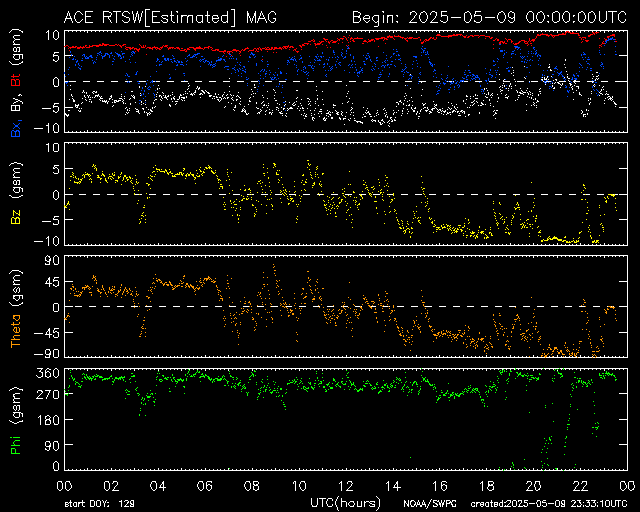
Btotal: 7.0 nT
Bz: 1.8 nT south
explanation | more data
Updated: Today at 1510 UT
Coronal Holes: 06 Sep 15

Solar wind flowing from the indicated coronal hole could reach Earth on Sept. 7. Credit: SDO/AIA.
Noctilucent Clouds
The northern season for NLCs is finished. According to NASA’s AIM spacecraft, the last clouds were observed over Greenland on Aug. 27th. Now the waiting begins for the southern season expected to begin in November.

Switch view: Europe, USA, Asia, Polar
Updated at: 09-01-2015 09:00:00
NOAA Forecasts
Updated at: 2015 Sep 05 2200 UTC
FLARE
0-24 hr
24-48 hr
CLASS M
01 %
01 %
CLASS X
01 %
01 %
Geomagnetic Storms:
Probabilities for significant disturbances in Earth’s magnetic field are given for three activity levels: active, minor storm, severe storm
Updated at: 2015 Sep 05 2200 UTC
Mid-latitudes
0-24 hr
24-48 hr
ACTIVE
15 %
25 %
MINOR
05 %
10 %
SEVERE
01 %
01 %
High latitudes
0-24 hr
24-48 hr
ACTIVE
15 %
15 %
MINOR
25 %
25 %
SEVERE
25 %
35 %
Space Weather Update: 09/06/2015




No comments:
Post a Comment