
By Spaceweather.com, 08/18/2015
(ALMOST NO) CHANCE OF FLARES: There are only two small sunspots on the Earth-facing side of the sun, and neither one has the type of unstable magnetic field that harbors energy for strong explosions. NOAA forecasters estimate a scant 1% chance of M- or X-type solar flares on Aug. 17th. Solar flare alerts: text or voice
NORTHERN LIGHTS RE-APPEAR IN THE ARCTIC: For the past few months, Arctic skies have been too bright to see auroras–even at midnight. Now, however, darkness is returning and so are the Northern Lights. On Aug. 17th, Marketa S. Murray photographed this outburst of auroras over Fairbanks, Alaska:

“Finally, we have enough darkness here in the land of the Midnight Sun for auroras to be visible,” says Murray. “It’s great to see them again.”
The outburst was the luminous aftershock of a CME that hit Earth’s magnetic field on Aug. 15th. The impact sparked a strong G3-class geomagnetic storm on Saturday, followed by lesser G1-class disturbances on Sunday and Monday. As Murray’s photo shows, Earth’s magnetic field is still unsettled on Aug. 17th. NOAA forecasters estimate a 40% to 60% chance of more geomagnetic storms in the next 24 hours. Aurora alerts: text or voice
SPRITES AND TROLLS AT THE EDGE OF SPACE: We all know what comes out of the bottom of thunderclouds: lightning. But rarely do we see what comes out of the top. On August 10th, astronauts onboard the International Space Station were perfectly positioned to observe red sprites dancing atop a cluster of storms in Mexico. They snapped this incredible photo:

This shows just how high sprites can go. The photo shows their red forms reaching all the way from the thunderstorm below to a layer of green airglow some 100 km above Earth’s surface. This means sprites touch the edge of space, alongside auroras, meteors and noctilucent clouds. They are a true space weather phenomenon.
A few minutes after the astronauts saw the sprites, they spotted a related creature–a “Troll.” It jumped up to the left of the sprites:

“Trolls are also known as ‘secondary transient luminous events,” explains Oscar van der Velde, a member of the Lightning Research Group at the Universitat Politècnica de Catalunya. “They are occasionally observed alongside big clusters of sprites, and they can reach 40-60 km high.”
Van der Velde says that sprites can actually pull Earth’s ionosphere down toward the thunderstorm. When the gap shrinks, and the local electric field intensifies, Trolls appear.
You don’t have to be onboard a spaceship to see these exotic forms of lightning. “Sprite chasers” regularly photograph the upward bolts from their own homes. Van der Velde has photographed Trolls from ground-level, too. “I recorded these trollslast October over a storm over the Mediterranean Sea west of Sardinia and Corsica,” he says. Browse the sprite gallery for more examples.
Realtime Space Weather Photo Gallery
All Sky Fireball Network
Every night, a network of NASA all-sky cameras scans the skies above the United States for meteoritic fireballs. Automated software maintained by NASA’s Meteoroid Environment Office calculates their orbits, velocity, penetration depth in Earth’s atmosphere and many other characteristics. Daily results are presented here on Spaceweather.com.
On Aug. 17, 2015, the network reported 25 fireballs.
(21 sporadics, 4 Perseids)

In this diagram of the inner solar system, all of the fireball orbits intersect at a single point–Earth. The orbits are color-coded by velocity, from slow (red) to fast (blue). [Larger image] [movies]
Near Earth Asteroids
Potentially Hazardous Asteroids (PHAs) are space rocks larger than approximately 100m that can come closer to Earth than 0.05 AU. None of the known PHAs is on a collision course with our planet, although astronomers are finding new ones all the time.
On August 18, 2015 there were 1605 potentially hazardous asteroids.
Recent & Upcoming Earth-asteroid encounters:
Asteroid
Date(UT)
Miss Distance
Size
2005 JF21
Aug 16
20.1 LD
1.6 km
2015 PT227
Aug 29
9.7 LD
73 m
2004 BO41
Aug 31
57.3 LD
1.2 km
1991 CS
Sep 4
62.1 LD
1.4 km
2014 KS76
Sep 14
8.7 LD
22 m
2004 TR12
Sep 15
58.8 LD
1.0 km
2000 FL10
Oct 10
65.7 LD
1.9 km
2011 QD48
Oct 17
67.5 LD
1.0 km
2014 UR
Oct 18
3.8 LD
21 m
2011 SE97
Oct 18
12 LD
50 m
2001 UY4
Oct 21
58.2 LD
1.0 km
Notes: LD means “Lunar Distance.” 1 LD = 384,401 km, the distance between Earth and the Moon. 1 LD also equals 0.00256 AU. MAG is the visual magnitude of the asteroid on the date of closest approach.
Current Conditions
Solar wind
speed: 451.1 km/sec
density: 2.4 protons/cm3
explanation | more data
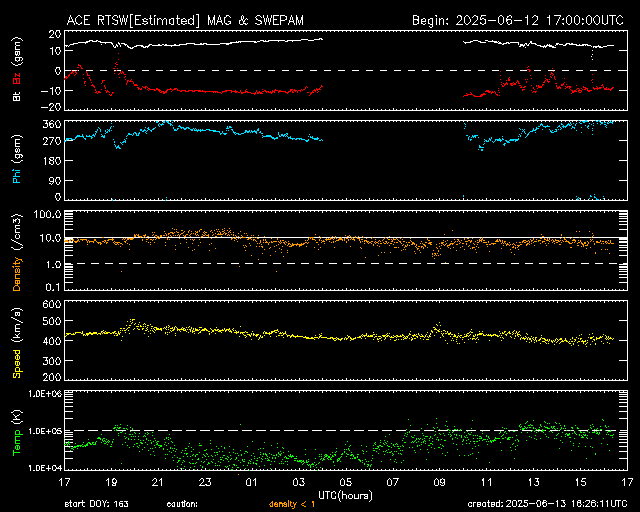
Updated: Today at 1348 UT
X-ray Solar Flares
6-hr max: B2 1138 UT Aug18
24-hr: B2 0023 UT Aug18
explanation | more data
Updated: Today at: 1300 UT
Daily Sun: 17 Aug 15

Neither of these sunspots poses a threat for strong solar flares. Credit: SDO/HMI
Sunspot number: 20
What is the sunspot number?
Updated 17 Aug 2015
Spotless Days
Current Stretch: 0 days
2015 total: 0 days (0%)
2014 total: 1 day (<1%)
2013 total: 0 days (0%)
2012 total: 0 days (0%)
2011 total: 2 days (<1%)
2010 total: 51 days (14%)
2009 total: 260 days (71%)
Updated 17 Aug 2015
The Radio Sun
10.7 cm flux: 86 sfu
explanation | more data
Updated 17 Aug 2015
Current Auroral Oval:

Switch to: Europe, USA, New Zealand, Antarctica
Credit: NOAA/Ovation
Planetary K-index
Now: Kp= 2 quiet
24-hr max: Kp= 4 unsettled
explanation | more data
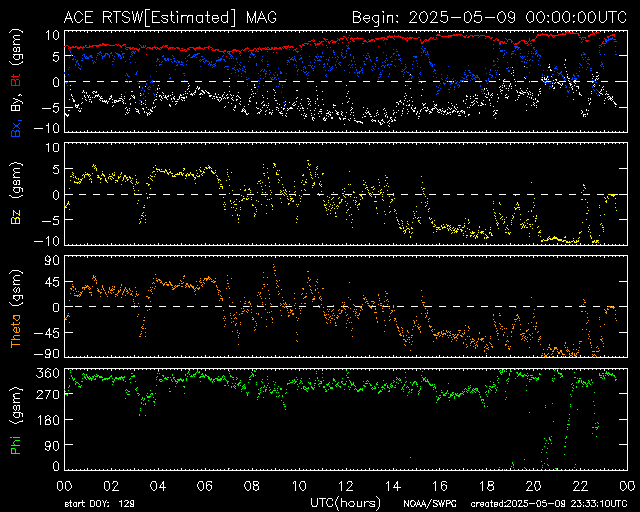
Interplanetary Mag. Field
Btotal: 3.3 nT
Bz: 1.7 nT south
explanation | more data
Updated: Today at 1349 UT
Coronal Holes: 17 Aug 15

Solar wind flowing from the indicated coronal hole could reach Earth on Aug. 20-21. Credit: SDO/AIA.
Noctilucent Clouds
The northern season for NLCs is underway. NASA’s AIM spacecraft spotted the first noctilucent clouds over the Arctic Circle on May 19th.

Switch view: Europe, USA, Asia, Polar
Updated at: 08-17-2015 19:55:02
NOAA Forecasts
Updated at: 2015 Aug 17 2200 UTC
FLARE
0-24 hr
24-48 hr
CLASS M
01 %
01 %
CLASS X
01 %
01 %
Geomagnetic Storms:
Probabilities for significant disturbances in Earth’s magnetic field are given for three activity levels: active, minor storm, severe storm
Updated at: 2015 Aug 17 2200 UTC
Mid-latitudes
0-24 hr
24-48 hr
ACTIVE
35 %
35 %
MINOR
25 %
10 %
SEVERE
05 %
01 %
High latitudes
0-24 hr
24-48 hr
ACTIVE
10 %
15 %
MINOR
25 %
30 %
SEVERE
60 %
45 %
Space Weather Update: 08/18/2015




No comments:
Post a Comment