
By Spaceweather.com, 08/29/2015
FISHY FULL MOON: According to folklore, this weekend’s full Moon is the Sturgeon Moon, named by Native American tribes of the Great Lakes who caught lots of sturgeon during the month of August. A Moon named after an ancient slimy fish? Go outside and take a look. It’s prettier than it sounds. [photo gallery]
SIMMERING GEOMAGNETIC STORM: For the third day in a row, Earth’s magnetic field is simmering with G1-class geomagnetic storms. The drawn-out event has ignited some of the first visible auroras in months around the Arctic Circle. Just hours ago, Jaromir Stanczyk witnessed this display over Iceland:

“The season has started well,” Stanczyk says. “The auroras were bright enough to see despite the glare of the Moon.”
NOAA forcasters estimate a 60% chance of continued geomagnetic storms onAug. 29th. Earth is inside a stream of high-speed solar wind that is buffeting our planet’s magnetic field, stirring up the Arctic lights. Polar sky watchers should remain alert for auroras tonight. Aurora alerts: text or voice
PROTON PERIL INCREASES AS SUNSPOT DEPARTS: Behemoth sunspot AR2403 is approaching the sun’s western limb where, soon, it will disappear from view. Maximilian Teodorescu sends this parting shot from Magurele, Romania:

“This photogenic sunspot is rapidly closing on the solar limb,” says Teodorescu. “I hope we see another one like it soon.”
As AR2403 turns away from Earth, the odds of a geoeffective explosion ironically increase. Magnetic fields near the sun’s western limb sweep back toward Earth, connecting our planet to the star: diagram. As the sunspot passes through this well-connected region, flares become extra-perilous. Protons and other subatomic particles accelerated by flares are guided by these sweeping magnetic fields right back toward Earth. NOAA forecasters estimate the odds of an X-flare to be 10% during the next 24 hours. Aurora alerts: text or voice
Realtime Space Weather Photo Gallery
SPACE YEAST SURVIVE AND MUTATE: Yeast and people have a lot in common. About 1/3rd of our DNA is the same. Indeed, the DNA of yeast is so similar to that of humans, yeast can actually live with human genes spliced into their genetic code. This is why Spaceweather.com and the students of Earth to Sky Calculus have been flying yeast to the edge of space. Understanding how the microbes respond to cosmic rays could tell us how human cells respond as well. Here are three strains of yeast (one per test tube) flying 113,936 feet above Earth’s surface on August 15th:

The student in the picture is Joey, a high school senior, hitching a ride to the stratosphere along with the yeast. Joey and other members of the student research team are busy measuring growth curves and mutation rates for the space-traveling yeast.
One result is already clear: Yeast are incredibly tough. En route to the stratosphere they were frozen solid at temperatures as low as -63C, and they experienced dose rates of ionizing radiation 100x Earth normal. Survival rates in some of the returning samples were close to 100%.
Photo-micrographs show that yeast mutates in the stratosphere. This image, for instance, shows a colony of white mutants alongside the normal red colonies ofSaccharomyces cerevisiae (HA2):

In addition to the white mutation shown above, the students have also observedpetite mutants, which are a sign of changes in the cells’ mitochondrial genome. These changes are of interest to space biologists because the DNA repair mechanisms of yeast are remarkably similar to those of human beings. In particular, proteins encoded by yeast RAD genes are closely related to proteins used by human cells to undo radiation damage.
Another flight of the yeast is scheduled for this Wednesday, Aug. 26th. What mutants will emerge this time? Stay tuned!
HEY THANKS: The students wish to say thanks to Dan Salkovitz, who sponsored the August 15th balloon flight. In exchange for his generous donation of $500, they flew Dan himself to the edge of space:

Readers, if you would like to sponsor an upcoming student research flight, and see your favorite picture flown to the stratosphere, please contact Dr. Tony Phillips to make arrangements.
All Sky Fireball Network
Every night, a network of NASA all-sky cameras scans the skies above the United States for meteoritic fireballs. Automated software maintained by NASA’s Meteoroid Environment Office calculates their orbits, velocity, penetration depth in Earth’s atmosphere and many other characteristics. Daily results are presented here on Spaceweather.com.
On Aug. 29, 2015, the network reported 13 fireballs.
(13 sporadics)

In this diagram of the inner solar system, all of the fireball orbits intersect at a single point–Earth. The orbits are color-coded by velocity, from slow (red) to fast (blue). [Larger image] [movies]
Near Earth Asteroids
Potentially Hazardous Asteroids (PHAs) are space rocks larger than approximately 100m that can come closer to Earth than 0.05 AU. None of the known PHAs is on a collision course with our planet, although astronomers are finding new ones all the time.
On August 29, 2015 there were 1607 potentially hazardous asteroids.
Recent & Upcoming Earth-asteroid encounters:
Asteroid
Date(UT)
Miss Distance
Size
2015 QS8
Aug 22
5 LD
19 m
2015 QT3
Aug 28
4.2 LD
71 m
2015 PT227
Aug 29
9.7 LD
69 m
2004 BO41
Aug 31
57.3 LD
1.2 km
1991 CS
Sep 4
62.1 LD
1.4 km
2014 KS76
Sep 14
8.7 LD
22 m
2004 TR12
Sep 15
58.8 LD
1.0 km
2000 FL10
Oct 10
65.7 LD
1.9 km
2011 QD48
Oct 17
67.5 LD
1.0 km
2014 UR
Oct 18
3.8 LD
21 m
2011 SE97
Oct 18
12 LD
50 m
2001 UY4
Oct 21
58.2 LD
1.0 km
Notes: LD means “Lunar Distance.” 1 LD = 384,401 km, the distance between Earth and the Moon. 1 LD also equals 0.00256 AU. MAG is the visual magnitude of the asteroid on the date of closest approach.
Current Conditions
Solar wind
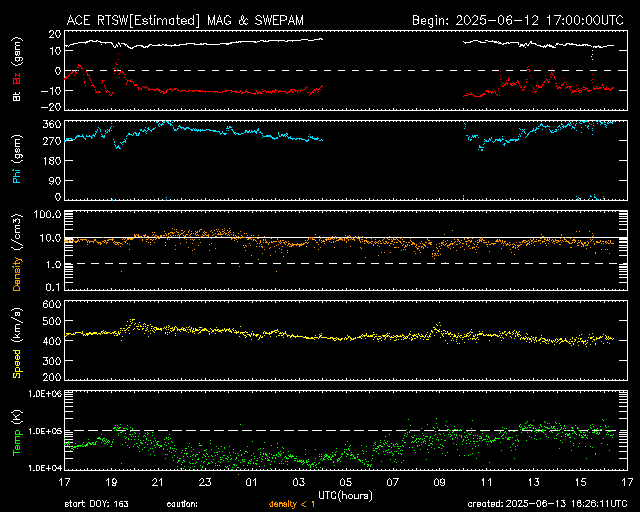
speed: 456.2 km/sec
density: 3.9 protons/cm3
explanation | more data
Updated: Today at 1819 UT
X-ray Solar Flares
6-hr max: C2 1527 UT Aug29
24-hr: C2 0732 UT Aug29
explanation | more data
Updated: Today at: 1800 UT
Daily Sun: 29 Aug 15

Sunspot AR2403 has a ‘beta-gamma-delta’ magnetic field that harbors energy for X-class solar flares. So far, however, this large sunspot has not lived up to its potential for strong flares. Credit: SDO/HMI
Sunspot number: 52
What is the sunspot number?
Updated 29 Aug 2015
Spotless Days
Current Stretch: 0 days
2015 total: 0 days (0%)
2014 total: 1 day (<1%)
2013 total: 0 days (0%)
2012 total: 0 days (0%)
2011 total: 2 days (<1%)
2010 total: 51 days (14%)
2009 total: 260 days (71%)
Updated 29 Aug 2015
The Radio Sun
10.7 cm flux: 109 sfu
explanation | more data
Updated 29 Aug 2015
Current Auroral Oval:

Switch to: Europe, USA, New Zealand, Antarctica
Credit: NOAA/Ovation
Planetary K-index
Now: Kp= 3 quiet
24-hr max: Kp= 5 storm
explanation | more data
Interplanetary Mag. Field
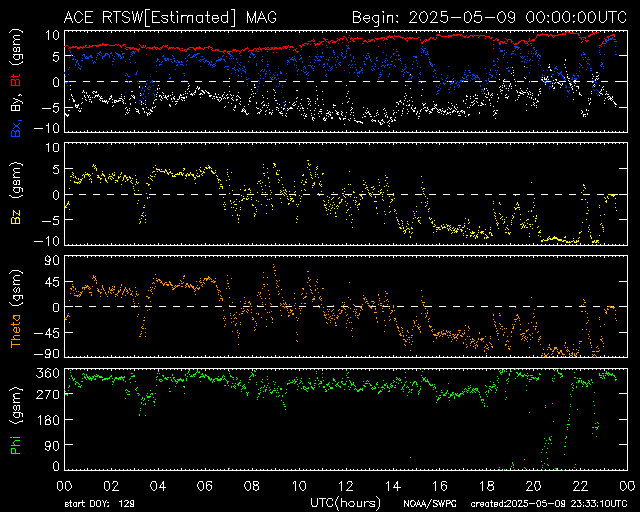
Btotal: 6.6 nT
Bz: 3.0 nT north
explanation | more data
Updated: Today at 1819 UT
Coronal Holes: 29 Aug 15

Earth is inside a stream of solar wind flowing from the indicated coronal hole. Credit: SDO/AIA.
Noctilucent Clouds
The northern season for NLCs is underway–but not for much longer. According to NASA’s AIM spacecraft, noctilucent clouds are waning as August comes to a close.

Switch view: Europe, USA, Asia, Polar
Updated at: 08-23-2015 16:55:02
NOAA Forecasts
Updated at: 2015 Aug 28 2200 UTC
FLARE
0-24 hr
24-48 hr
CLASS M
60 %
60 %
CLASS X
10 %
10 %
Geomagnetic Storms:
Probabilities for significant disturbances in Earth’s magnetic field are given for three activity levels: active, minor storm, severe storm
Updated at: 2015 Aug 28 2200 UTC
Mid-latitudes
0-24 hr
24-48 hr
ACTIVE
40 %
30 %
MINOR
25 %
10 %
SEVERE
05 %
01 %
High latitudes
0-24 hr
24-48 hr
ACTIVE
10 %
15 %
MINOR
25 %
30 %
SEVERE
60 %
40 %
Space Weather Update: 08/29/2015




No comments:
Post a Comment