
By Spaceweather.com, 08/31/2015
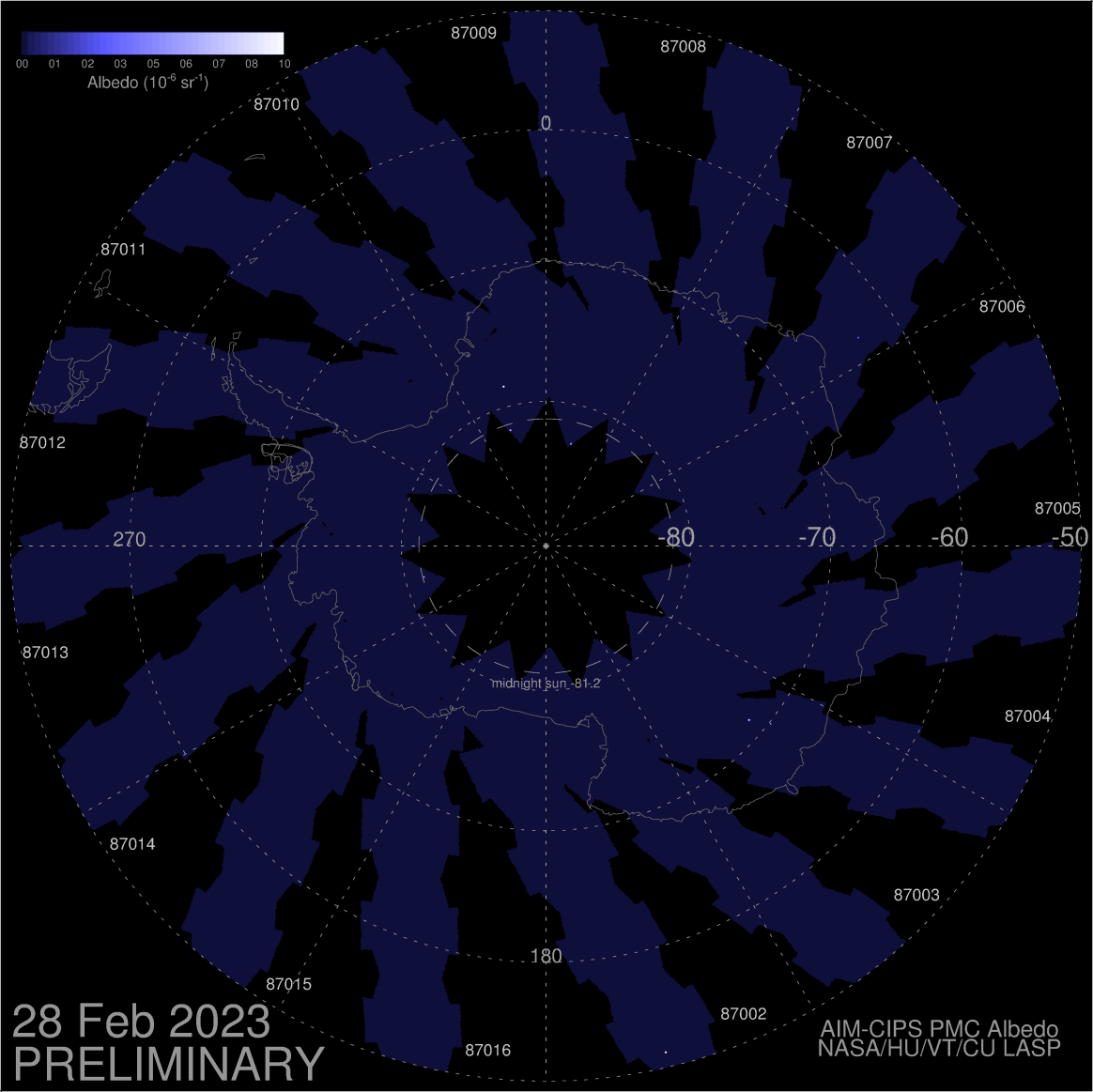
NOCTILUCENT CLOUDS VANISH: Summer is the season for noctilucent clouds(NLCs), and now that northern summer is coming to an end, so are the clouds. NASA’s AIM spacecraft may have spotted the last wisp of electric blue over Greenland on Aug. 27th. Data from Aug. 28th show no NLCs around the Arctic Circle. If the deficit continues, attention will shift to the southern hemisphere where Antarctic noctilucent cloud season begins in November. Stay tuned for updates.
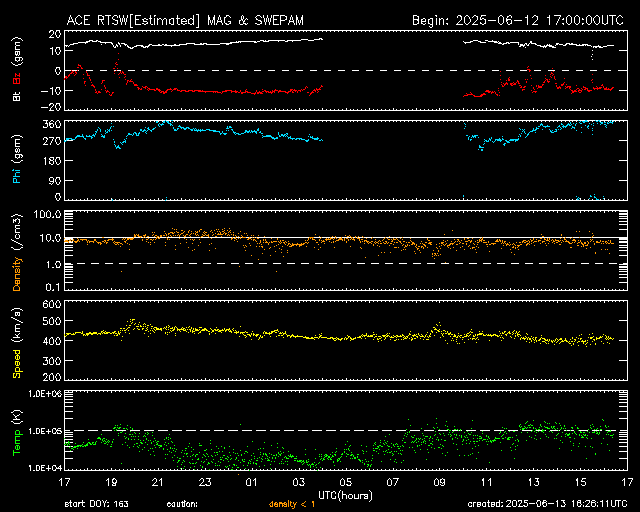
NORTHERN LIGHTS, NO PARKA REQUIRED: Arctic skies are dimming again after a rare burst of summer auroras. From Aug. 26th to 29th, Earth passed through a region of space where the interplanetary magnetic field (IMF) connected with our own magnetic field, opening a crack in Earth’s magnetosphere. Solar wind poured in to fuel displays like this one over Anchorage, Alaska:

“The sky was full of lights,” says Anthony Madden, who took the picture from Lake Hood Airport on Aug. 28th. “The best part was, it was warm enough that I did not need a parka.”
The storms are subsiding now, but they could return on Sept. 2nd when Earth crosses through a fold in the heliospheric current sheet. This is called a “solar sector boundary crossing,” and NOAA forecasters estimate a 70% chance of polar geomagnetic storms when it occurs. Aurora alerts: text or voice
THE EDGE OF THE SUN: Giant sunspot AR2403 has departed, leaving the face of the sun mostly blank. Amateur astronomer Sergio Castillo of Corona, CA, decided to look for something else to photograph. “My search didn’t take long,” he says, “because there are plenty of beautiful prominences on the solar limb.” This is what he saw on Aug. 29th:

The massive structure is more than 30,000 km tall and 100,000 km wide. Planet Earth could fit through the central arch with room to spare. (Croquette, anyone?)
Prominences are plumes of hot plasma held aloft by magnetic fields on the sun. Typical prominences last a few days, until the underlying magnetic supports become unstable and collapse. This one has already been visible for several days, so a photogenic explosion could be in the offing. Amateur astronomers with solar telescopes and filters are encouraged to monitor developments.
Realtime Space Weather Photo Gallery
THE SUN SWALLOWS A COMET: On Friday, Aug.28th, the sun swallowed a comet. The Solar and Heliospheric Observatory (SOHO) spotted the icy vistor from the outer solar system making a headlong plunge into our star. One comet went in; none came out. Click to play the movie:

Heated by the sun at point blank range, the comet’s fragile ices vaporized, leaving at most a “rubble pile” of rock and gravel scattered along its sungrazing orbit. Any remains are invisible from Earth.
The comet, R.I.P., was probably a member of the Kreutz family. Kreutz sungrazersare fragments from the breakup of a single giant comet many centuries ago. They get their name from 19th century German astronomer Heinrich Kreutz, who studied them in detail. Several Kreutz fragments pass by the sun and disintegrate every day. Most, measuring less than a few meters across, are too small to see, but occasionally a bigger fragment like this one (~10 m to 50 m) attracts attention.
Because of their common parentage, sungrazers often come in clusters. For this reason, it wouldn’t be surprising to find yet another one in the offing. Monitor Karl Battam’s Sungrazing Comet twitter feed for more sightings.
Realtime Space Weather Photo Gallery
All Sky Fireball Network
Every night, a network of NASA all-sky cameras scans the skies above the United States for meteoritic fireballs. Automated software maintained by NASA’s Meteoroid Environment Office calculates their orbits, velocity, penetration depth in Earth’s atmosphere and many other characteristics. Daily results are presented here on Spaceweather.com.
On Aug. 31, 2015, the network reported 17 fireballs.
(16 sporadics, 1 alpha Aurigid)

In this diagram of the inner solar system, all of the fireball orbits intersect at a single point–Earth. The orbits are color-coded by velocity, from slow (red) to fast (blue). [Larger image] [movies]
On August 31, 2015 there were 1607 potentially hazardous asteroids.
Recent & Upcoming Earth-asteroid encounters:
Asteroid
Date(UT)
Miss Distance
Size
2015 QT3
Aug 28
4.2 LD
71 m
2015 PT227
Aug 29
9.7 LD
69 m
2004 BO41
Aug 31
57.3 LD
1.2 km
1991 CS
Sep 4
62.1 LD
1.4 km
2014 KS76
Sep 14
8.7 LD
22 m
2004 TR12
Sep 15
58.8 LD
1.0 km
2000 FL10
Oct 10
65.7 LD
1.9 km
2011 QD48
Oct 17
67.5 LD
1.0 km
2014 UR
Oct 18
3.8 LD
21 m
2011 SE97
Oct 18
12 LD
50 m
2001 UY4
Oct 21
58.2 LD
1.0 km
Notes: LD means “Lunar Distance.” 1 LD = 384,401 km, the distance between Earth and the Moon. 1 LD also equals 0.00256 AU. MAG is the visual magnitude of the asteroid on the date of closest approach.
Current Conditions
Solar wind
speed: 373.0 km/sec
density: 4.4 protons/cm3
explanation | more data
Updated: Today at 1429 UT
X-ray Solar Flares
6-hr max: B4 0936 UT Aug31
24-hr: C2 0522 UT Aug31
explanation | more data
Updated: Today at: 1400 UT
Daily Sun: 31 Aug 15

With the departure of huge sunspot AR2403, the Earth-facing side of the sun is almost blank.. Credit: SDO/HMI
Sunspot number: 50
What is the sunspot number?
Updated 31 Aug 2015
Spotless Days
Current Stretch: 0 days
2015 total: 0 days (0%)
2014 total: 1 day (<1%)
2013 total: 0 days (0%)
2012 total: 0 days (0%)
2011 total: 2 days (<1%)
2010 total: 51 days (14%)
2009 total: 260 days (71%)
Updated 31 Aug 2015
The Radio Sun
10.7 cm flux: 92 sfu
explanation | more data
Updated 31 Aug 2015
Current Auroral Oval:

Switch to: Europe, USA, New Zealand, Antarctica
Credit: NOAA/Ovation
Planetary K-index
Now: Kp= 2 quiet
24-hr max: Kp= 2 quiet
explanation | more data
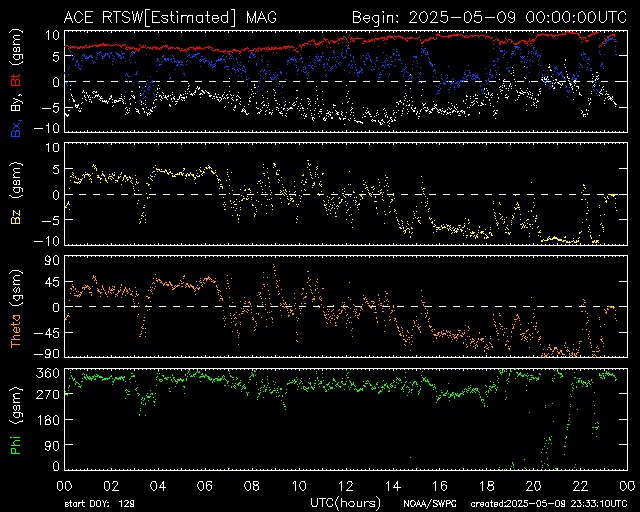
Interplanetary Mag. Field
Btotal: 4.7 nT
Bz: 1.6 nT north
explanation | more data
Updated: Today at 1429 UT
Coronal Holes: 31 Aug 15

A stream of solar wind flowing from the indicated coronal hole should reach Earth on or about Sept. 3rd. Credit: SDO/AIA.
Noctilucent Clouds
The northern season for NLCs is underway–but not for much longer. According to NASA’s AIM spacecraft, noctilucent clouds are waning as August comes to a close.

Switch view: Europe, USA, Asia, Polar
Updated at: 08-30-2015 12:30:00
NOAA Forecasts
Updated at: 2015 Aug 30 2200 UTC
FLARE
0-24 hr
24-48 hr
CLASS M
40 %
01 %
CLASS X
05 %
01 %
Geomagnetic Storms:
Probabilities for significant disturbances in Earth’s magnetic field are given for three activity levels: active, minor storm, severe storm
Updated at: 2015 Aug 30 2200 UTC
Mid-latitudes
0-24 hr
24-48 hr
ACTIVE
15 %
45 %
MINOR
01 %
25 %
SEVERE
01 %
05 %
High latitudes
0-24 hr
24-48 hr
ACTIVE
15 %
10 %
MINOR
25 %
25 %
SEVERE
20 %
70 %
Space Weather Update: 08/31/2015





No comments:
Post a Comment