
By Spaceweather.com, 08/14/2015
QUIET WITH A CHANCE OF FLARES: Emerging sunspot AR2401 is crackling with minor C-class solar flares. More potent eruptions could be in the offing if the sunspot continues to grow as rapidly as it has in the past 24 hours. NOAA forecasters estimate a 10% chance of M-class solar flares on August 14th. Solar flare alerts: text or voice
GIGANTIC JETS ABOVE HURRICANE HILDA: Yesterday, we reported a rare apparition of sprites above Hurricane Hilda. Steve Cullen, who lives in Hawaii where the storm is heading, spotted them in video from the Canada-France-Hawaii Telescope CloudCam atop Maunakea. A closer look at the video, however, reveals that the dancing forms were not sprites. Instead, Hurricane Hilda has gigantic jets:

Think of them as sprites on steroids: Gigantic jets are lightning-like discharges that spring from the tops of thunderstorms, reaching all the way from the thunderhead to the ionosphere more than 50 miles overhead. They’re enormous and powerful.
“Gigantic jets are much more rare than sprites,” says Oscar van der Velde, a member of the Lightning Research Group at the Universitat Politècnica de Catalunya. “While sprites were discovered in 1989 and have since been photographed by the thousands, it was not until 2001-2002 that gigantic jets were first recorded from Puerto Rico and Taiwan.” Only a few dozen gigantic jets have ever been seen, mostly over open ocean.
Because gigantic jets are so rare, researchers are paying special attention to Hurricane Hilda. “Observations in recent years suggest that large thunderstorm clusters embedded in tropical cyclones harbor favorable conditions for gigantic jets. Hilda seems to confirm this. Extreme turbulent mixing in the storm top may assist in triggering these events,” he says.
Stay tuned for more observations of Hilda’s cloudtops as it approaches Hawaii.
PERSEID METEOR SHOWER: Last night’s Perseid meteor shower put on a fine display. NASA’s all sky network of meteor cameras detected more than 300 Perseid fireballs over the USA alone. Elsewhere, observers working with the International Meteor Organization counted as many as 100 meteors per hour from dark-sky sites around the world. Here is an example from a campsite in Nykøbing Mors, Denmark:

“This was the best night in my whole astrophotography experience,” reports photographer Ruslan Merzlyakov. “The Danish night sky was absolutely clear during the special sky event! Lots of Perseids and Northern Lights exploded in the sky right over my hometown. For once I am not going to argue with Danish weather, because I am 200% happy!”
The show isn’t over yet. Earth is still inside a stream of debris from comet 109P/Swift-Tuttle, the source of the Perseids. Rates will probably decrease on the night of August 13-14, but not to zero. No matter where you live, the best time to look is during the dark hours before sunrise on Friday.
Realtime Space Weather Photo Gallery
All Sky Fireball Network
Every night, a network of NASA all-sky cameras scans the skies above the United States for meteoritic fireballs. Automated software maintained by NASA’s Meteoroid Environment Office calculates their orbits, velocity, penetration depth in Earth’s atmosphere and many other characteristics. Daily results are presented here on Spaceweather.com.
On Aug. 14, 2015, the network reported 163 fireballs.
(82 Perseids, 75 sporadics, 2 Southern delta Aquariids, 1 Northern delta Aquariid, 1 kappa Cygnid, 1 , 1)

In this diagram of the inner solar system, all of the fireball orbits intersect at a single point–Earth. The orbits are color-coded by velocity, from slow (red) to fast (blue). [Larger image] [movies]
Near Earth Asteroids
Potentially Hazardous Asteroids (PHAs) are space rocks larger than approximately 100m that can come closer to Earth than 0.05 AU. None of the known PHAs is on a collision course with our planet, although astronomers are finding new ones all the time.
On August 14, 2015 there were 1603 potentially hazardous asteroids.
Recent & Upcoming Earth-asteroid encounters:
Asteroid
Date(UT)
Miss Distance
Size
2015 PL9
Aug 8
1.2 LD
16 m
2005 JF21
Aug 16
20.1 LD
1.6 km
2004 BO41
Aug 31
57.3 LD
1.2 km
1991 CS
Sep 4
62.1 LD
1.4 km
2014 KS76
Sep 14
8.7 LD
22 m
2004 TR12
Sep 15
58.8 LD
1.0 km
2000 FL10
Oct 10
65.7 LD
1.9 km
2011 QD48
Oct 17
67.5 LD
1.0 km
2014 UR
Oct 18
3.8 LD
21 m
2011 SE97
Oct 18
12 LD
50 m
2001 UY4
Oct 21
58.2 LD
1.0 km
Notes: LD means “Lunar Distance.” 1 LD = 384,401 km, the distance between Earth and the Moon. 1 LD also equals 0.00256 AU. MAG is the visual magnitude of the asteroid on the date of closest approach.
Current Conditions
Solar wind
speed: 332.9 km/sec
density: 2.3 protons/cm3
explanation | more data
Updated: Today at 1529 UT
X-ray Solar Flares
6-hr max: B3 0951 UT Aug14
24-hr: C1 0200 UT Aug14
explanation | more data
Updated: Today at: 1500 UT
Daily Sun: 14 Aug 15

New sunspot AR2401 is crackling withC-class solar flares. Credit: SDO/HMI
Sunspot number: 51
What is the sunspot number?
Updated 13 Aug 2015
Spotless Days
Current Stretch: 0 days
2015 total: 0 days (0%)
2014 total: 1 day (<1%)
2013 total: 0 days (0%)
2012 total: 0 days (0%)
2011 total: 2 days (<1%)
2010 total: 51 days (14%)
2009 total: 260 days (71%)
Updated 14 Aug 2015
The Radio Sun
10.7 cm flux: 95 sfu
explanation | more data
Updated 14 Aug 2015
Current Auroral Oval:

Switch to: Europe, USA, New Zealand, Antarctica
Credit: NOAA/Ovation
Planetary K-index
Now: Kp= 1 quiet
24-hr max: Kp= 1 quiet
explanation | more data
Interplanetary Mag. Field
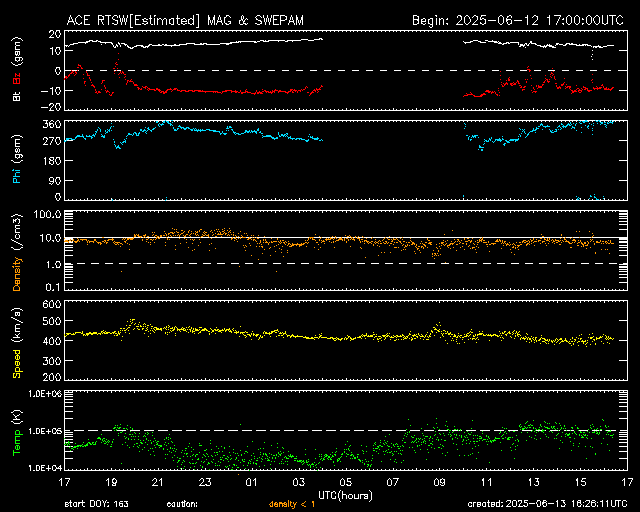
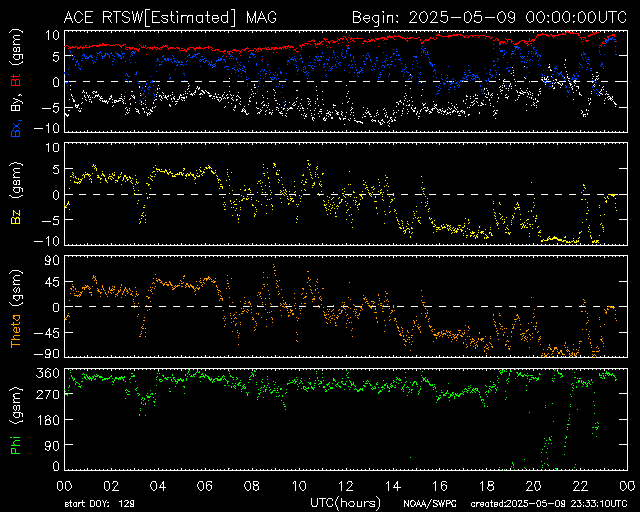
Btotal: 10.4 nT
Bz: 1.7 nT north
explanation | more data
Updated: Today at 1529 UT
Coronal Holes: 13 Aug 15

Solar wind flowing from the indicated coronal hole could reach Earth on Aug. 16-17. Credit: SDO/AIA.
Noctilucent Clouds
The northern season for NLCs is underway. NASA’s AIM spacecraft spotted the first noctilucent clouds over the Arctic Circle on May 19th.

Switch view: Europe, USA, Asia, Polar
Updated at: 08-14-2015 01:55:03
NOAA Forecasts
Updated at: 2015 Aug 13 2200 UTC
FLARE
0-24 hr
24-48 hr
CLASS M
10 %
05 %
CLASS X
01 %
01 %
Geomagnetic Storms:
Probabilities for significant disturbances in Earth’s magnetic field are given for three activity levels: active, minor storm, severe storm
Updated at: 2015 Aug 13 2200 UTC
Mid-latitudes
0-24 hr
24-48 hr
ACTIVE
10 %
10 %
MINOR
01 %
01 %
SEVERE
01 %
01 %
High latitudes
0-24 hr
24-48 hr
ACTIVE
15 %
15 %
MINOR
15 %
15 %
SEVERE
15 %
15 %
Space Weather Update: 08/14/2015




No comments:
Post a Comment