
By Spaceweather.com, 08/12/2015
PERSEID METEOR SHOWER–TONIGHT! The annual Perseid meteor shower is underway. Dusty debris from Comet Swift-Tuttle is hitting the top of Earth’s atmosphere at 59+ km/s (130,000 mph) and disintegrating in streaks of light that fly out of the constellation Perseus. On Tuesday morning, Kevin Lewis caught this Perseid streaking down the Milky Way over Cwyfan, Anglesey, UK:

“I was making a deep exposure of the galactic plane on August 11th when the meteor appeared,” says Lewis.
Many more could appear tonight. Forecasters expect meteor rates to top 100 per hour on August 12-13 when Earth passes through the heart of Swift-Tuttle’s debris stream. The best time to look, no matter where you live, is during the dark hours before dawn when the constellation Perseus is high in the sky. City lights will overwhelm many Perseids. For full effect, go to the countryside where a velvet-dark sky provides the backdrop for a fine display.
Got clouds? You can listen to radar echoes from Perseid meteoroids on [Space Weather Radio.
SOLAR RADIO BURSTS: For the past week, solar activity has been low. However, the sun has not been quiet. “I have noted that the sun has been extremely dynamic at shortwave radio wavelengths with almost constant Type III bursting,” reports Thomas Ashcraft of New Mexico. He has been hearing loud bursts of static coming from the loudspeaker of his amateur radio telescope whenever he points it at the sun. Click on the dynamic spectrum below to hear a sample:

Type III solar radio bursts are caused by solar flares. Electrons accelerated by strong flares race through the sun’s atmosphere, causing a ripple of plasma waves and radio static. Yet, ironically, there have been no strong solar flares. Nevertheless, suggests Ashcraft, “all of the bursting indicates a lot of magnetic complexity and movement in the sunspots.”
The biggest sunspot of all, AR2396, is about to rotate off the western edge of the sun. After it departs, the static might subside. Until then, shortwave radio operators should remain alert for solar bursts. The sun is not so quiet, after all. Solar flare alerts: text or voice
Realtime Space Weather Photo Gallery
A SLIVER OF VENUS: On August 15th, Venus will pass almost directly between Earth and the sun–an event astronomers call “inferior solar conjunction.” As Venus approaches the sun, the planet is turning its night side toward Earth, reducing its luminous glow to a thin sliver. Damian Peach sends this image of the narrowing crescent from his private observatory in Selsey, UK:

In the days ahead, the crescent of Venus will become increasingly thin and circular. The horns of the crescent might actually touch when the Venus-sun angle is least on August 15th (7.9o). This is arguably the most beautiful time to observe Venus–but also the most perilous. The glare of the nearby sun magnified by a telescope can damage the eyes of anyone looking through the eyepiece.
Anthony J. Cook of the Griffith Observatory has some advice for observers: “I have observed Venus at conjunction, but only from within the shadow of a building, or by adding a mask to the front end of the telescope to fully shadow the optics from direct sunlight. This is tricky with a refractor or a catadioptric, because the optics start at the front end of the tube. Here at Griffith Observatory, I rotate the telescope dome to make sure the lens of the telescope is shaded from direct sunlight, even through it means that the lens will be partially blocked when aimed at Venus. With our Newtonian telescope, I add a curved cardboard mask at the front end of the tube to shadow the primary mirror.”
Potential observers should take precautions as outlined above. That said, if you have a GOTO telescope, command it to slew to Venus this evening. The slender cresent is only 12o from the sun on Aug. 8th, and it’s a beauty!
All Sky Fireball Network
Every night, a network of NASA all-sky cameras scans the skies above the United States for meteoritic fireballs. Automated software maintained by NASA’s Meteoroid Environment Office calculates their orbits, velocity, penetration depth in Earth’s atmosphere and many other characteristics. Daily results are presented here on Spaceweather.com.
On Aug. 12, 2015, the network reported 195 fireballs.
(121 sporadics, 67 Perseids, 2 Northern delta Aquariids, 2 , 1 Southern iota Aquariid, 1 Southern delta Aquariid, 1 alpha Capricornid)

In this diagram of the inner solar system, all of the fireball orbits intersect at a single point–Earth. The orbits are color-coded by velocity, from slow (red) to fast (blue). [Larger image] [movies]
Near Earth Asteroids
Potentially Hazardous Asteroids (PHAs) are space rocks larger than approximately 100m that can come closer to Earth than 0.05 AU. None of the known PHAs is on a collision course with our planet, although astronomers are finding new ones all the time.
On August 12, 2015 there were 1603 potentially hazardous asteroids.
Recent & Upcoming Earth-asteroid encounters:
Asteroid
Date(UT)
Miss Distance
Size
2015 PK
Aug 6
0.2 LD
10 m
2005 NZ6
Aug 6
76.5 LD
1.4 km
2015 PK9
Aug 7
5.8 LD
80 m
2015 PL9
Aug 8
1.2 LD
16 m
2005 JF21
Aug 16
20.1 LD
1.6 km
2004 BO41
Aug 31
57.3 LD
1.2 km
1991 CS
Sep 4
62.1 LD
1.4 km
2014 KS76
Sep 14
8.7 LD
22 m
2004 TR12
Sep 15
58.8 LD
1.0 km
2000 FL10
Oct 10
65.7 LD
1.9 km
2011 QD48
Oct 17
67.5 LD
1.0 km
2014 UR
Oct 18
3.8 LD
21 m
2011 SE97
Oct 18
12 LD
50 m
2001 UY4
Oct 21
58.2 LD
1.0 km
Notes: LD means “Lunar Distance.” 1 LD = 384,401 km, the distance between Earth and the Moon. 1 LD also equals 0.00256 AU. MAG is the visual magnitude of the asteroid on the date of closest approach.
Current Conditions
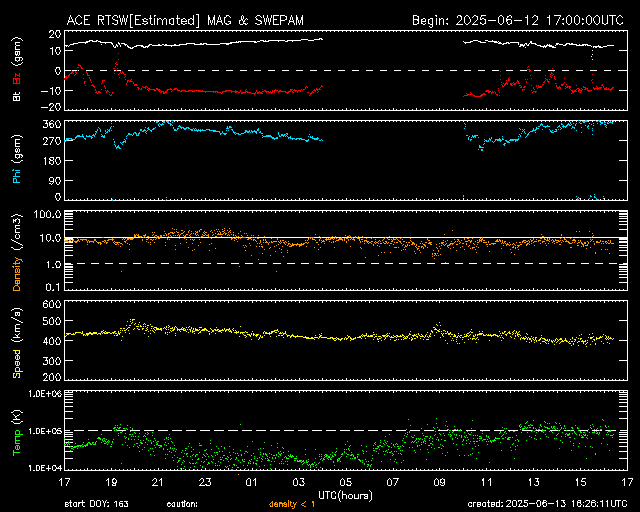
Solar wind
speed: 394.5 km/sec
density: 3.7 protons/cm3
explanation | more data
Updated: Today at 1429 UT
X-ray Solar Flares
6-hr max: B6 1029 UT Aug12
24-hr: B6 1029 UT Aug12
explanation | more data
Updated: Today at: 1400 UT
Daily Sun: 12 Aug 15

Departing sunspot AR2396 poses a waning threat for M-class solar flares. Credit: SDO/HMI
Sunspot number: 87
What is the sunspot number?
Updated 12 Aug 2015
Spotless Days
Current Stretch: 0 days
2015 total: 0 days (0%)
2014 total: 1 day (<1%)
2013 total: 0 days (0%)
2012 total: 0 days (0%)
2011 total: 2 days (<1%)
2010 total: 51 days (14%)
2009 total: 260 days (71%)
Updated 12 Aug 2015
The Radio Sun
10.7 cm flux: 103 sfu
explanation | more data
Updated 12 Aug 2015
Current Auroral Oval:

Switch to: Europe, USA, New Zealand, Antarctica
Credit: NOAA/Ovation
Planetary K-index
Now: Kp= 1 quiet
24-hr max: Kp= 3 quiet
explanation | more data
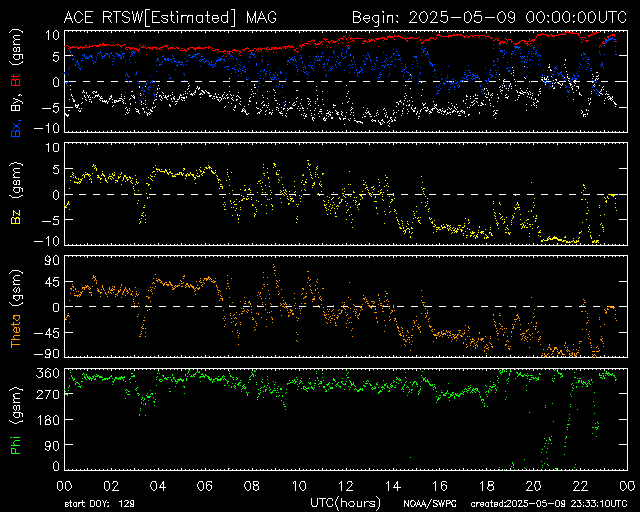
Interplanetary Mag. Field
Btotal: 7.3 nT
Bz: 0.4 nT south
explanation | more data
Updated: Today at 1429 UT
Coronal Holes: 12 Aug 15

Solar wind flowing from the indicated coronal hole could reach Earth on Aug. 16th. Credit: SDO/AIA.
Noctilucent Clouds
The northern season for NLCs is underway. NASA’s AIM spacecraft spotted the first noctilucent clouds over the Arctic Circle on May 19th.

Switch view: Europe, USA, Asia, Polar
Updated at: 08-12-2015 02:55:02
NOAA Forecasts
Updated at: 2015 Aug 11 2200 UTC
FLARE
0-24 hr
24-48 hr
CLASS M
25 %
25 %
CLASS X
05 %
05 %
Geomagnetic Storms:
Probabilities for significant disturbances in Earth’s magnetic field are given for three activity levels: active, minor storm, severe storm
Updated at: 2015 Aug 11 2200 UTC
Mid-latitudes
0-24 hr
24-48 hr
ACTIVE
10 %
10 %
MINOR
01 %
01 %
SEVERE
01 %
01 %
High latitudes
0-24 hr
24-48 hr
ACTIVE
15 %
15 %
MINOR
20 %
15 %
SEVERE
10 %
15 %
Space Weather Update: 08/12/2015




No comments:
Post a Comment